
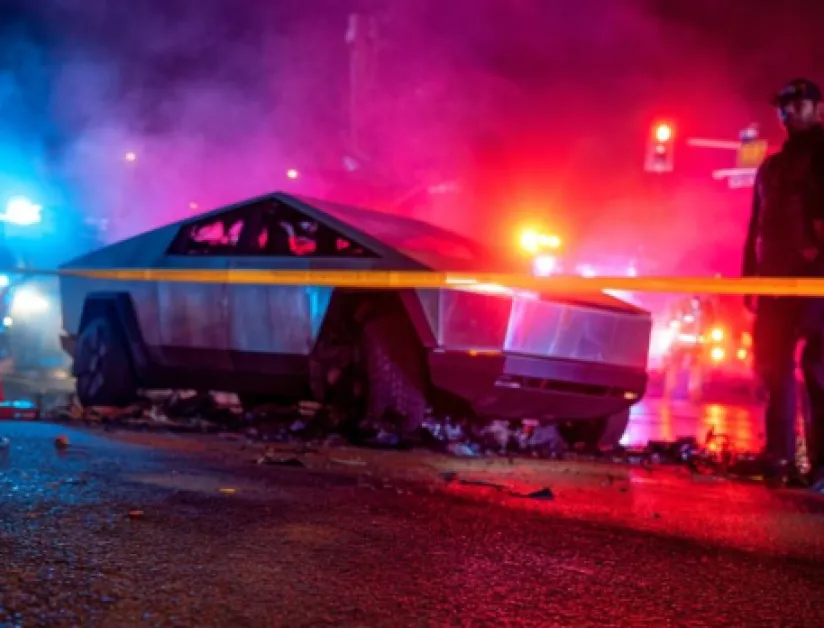
The sports world is stunned by the tragic loss of a former NFL player in a fiery crash that’s ignited fierce debate about electric vehicle safety and the future of Tesla’s most ambitious truck.Late last night, on the outskirts of Baytown, Texas, 47-year-old Michael Sheehan — a man later identified via license plate records as a former New Orleans Saints player (pending DNA confirmation by authorities) — was returning home in his six-month-old Tesla Cybertruck when disaster struck. The vehicle veered into a concrete ditch, flipped, and erupted in flames.
In the frantic, smoke-filled seconds that followed, Sheehan found himself trapped. The truck’s power had failed. Electric doors stayed locked. The hidden manual door handles, praised for their futuristic minimalism, proved impossible to locate in the darkness and chaos. Bystanders could do nothing. Sheehan suffocated inside what was marketed as the “future of transportation.”
His family’s attorney has since filed suit against Tesla in Harris County court, arguing the Cybertruck’s design fatally disregards basic safety standards — with doors entirely dependent on electricity, hidden handles, and a battery pack prone to thermal runaway in high-impact crashes.
The incident, already labeled “every family’s nightmare” by local officials, has cast a grim shadow over the Cybertruck’s image. Launched with fanfare in late 2023 as a symbol of Elon Musk’s vision, the truck has faced at least eight recalls for issues ranging from sticky accelerators to malfunctioning wipers. None, of course, as serious as a failure to escape during a fire.
Worse still, Michael Sheehan’s case isn’t isolated. Industry insiders and safety advocates now question if the Cybertruck’s bold minimalism sacrifices human life for style. Unlike most trucks, which allow mechanical exit even during power loss, Tesla’s hidden handles and electronic locks pose a dire risk in emergencies, especially with battery fires that escalate by the second.
While Tesla claims all Cybertrucks have internal manual releases, experts warn that in panic, darkness, and toxic smoke, such features may as well not exist. The truck’s massive battery — praised for power and range — is also under fire for its potential to heat up and ignite in crashes, creating what some are now calling “rolling crematoriums.”
The Sheehan family is seeking over $1 million in damages. Meanwhile, the NHTSA and safety organizations are moving toward a full investigation of Cybertruck’s doors, batteries, and escape protocols. But for Sheehan’s loved ones, it’s already too late. Their loss is permanent, blamed on a truck that was “too smart for its own good.”
A vehicle once hailed as a breakthrough now faces an uncertain future. Each Cybertruck on the road carries not just promise, but fear: in the age of tech, what’s meant to protect can become a deadly trap. Michael Sheehan’s death is a sobering warning to Tesla and the entire EV industry — no design or innovation should ever come before human safety.Stay tuned to ESPN.
