
The Green Bay Packers’ recent clash with the Cleveland Browns was a hard-fought battle, ending in disappointment for Packers fans after a narrow defeat. But while the scoreboard told one story, the postgame moments told another — one of raw emotion, resilience, and a message far larger than football.
Running back Josh Jacobs, playing in his first season with Green Bay, became the unexpected center of attention not only for his performance on the field but for the powerful revelation he made afterward.
A Tattoo That Carried a Message
Throughout the game, fans noticed a new tattoo etched on Jacobs’ arm. It carried the distinct colors and symbol associated with mental health awareness, alongside the number “988” — the three-digit Suicide & Crisis Lifeline introduced in the United States to provide immediate help to those in emotional distress.
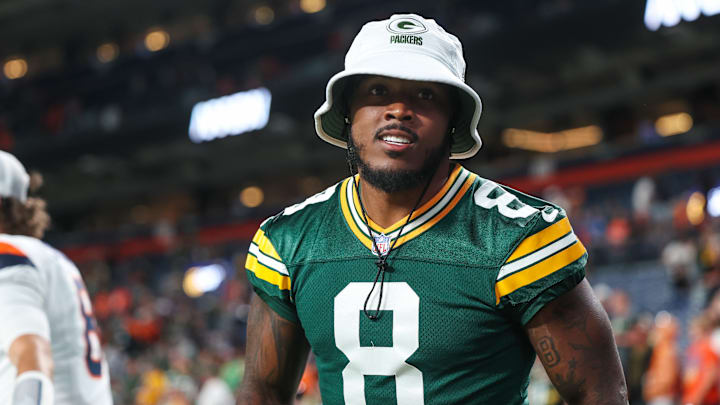
Social media quickly picked up on it, with photos circulating and speculation rising about its meaning. For many, it was clear that Jacobs’ ink wasn’t just about style but about purpose.
The confirmation came after the final whistle, when Jacobs stepped in front of the media with a trembling voice and shared his heart.
A Son’s Dedication
Visibly shaken after the loss, Jacobs spoke not about plays or strategy but about his father.
“I’m sorry, Dad,” he began, his voice cracking. “Today I couldn’t bring home the victory, but I still dedicate every ounce of my effort to you…”
The stadium may have emptied, but his words reverberated across the sports world. Fans watching from home felt the weight of a man balancing grief, love, and responsibility. His tattoo, he explained, was a tribute to both his father and to all who battle silently with mental health struggles.
A $988,000 Commitment
Even in defeat, Jacobs delivered a victory of another kind. Following his heartfelt words, he announced a donation of $988,000 to the Suicide & Crisis Lifeline.
The symbolism was unmistakable: the donation amount matched the hotline number, further amplifying the message of awareness and support.
“Everyone has the right to live in a loving environment,” Jacobs declared. “Too many people are suffering in silence. If sharing my story or giving back in this way can help even one person choose life, then it’s worth everything.”
A Larger Conversation in Football
Jacobs’ decision to shine a light on suicide prevention and mental health comes at a critical moment, both within and beyond the NFL. For years, the league has battled stigma around mental health, with many players reluctant to share their struggles for fear of being seen as weak.
But as stars like Jacobs open up, that narrative is changing. His tattoo, his words, and his donation serve as a reminder that athletes — often perceived as invincible — face the same struggles as anyone else.
Packers head coach Matt LaFleur praised Jacobs’ courage: “What Josh did tonight showed true strength. He reminded all of us that there are battles more important than football, and his willingness to be vulnerable is inspiring.”
Fans and Community React
The response was immediate and overwhelming. On social media, hashtags like #988Strong and #JoshJacobs began trending within hours. Fans from Green Bay and beyond shared stories of their own struggles and thanked Jacobs for bringing visibility to an issue that affects millions of families.
Mental health advocates were equally quick to highlight the impact. “When a high-profile athlete like Josh Jacobs steps up and speaks openly, it normalizes the conversation,” said Dr. Sarah Benson, director of a national suicide prevention group. “His donation will help, but his courage to share is what will truly save lives.”
Beyond the Field
For Jacobs, this moment wasn’t about publicity — it was about purpose. His journey to the NFL has been marked by resilience, from a childhood of hardship to becoming one of the league’s most powerful running backs. Now, he is using that platform for something far greater than himself.
By intertwining his personal grief with a public call to action, Jacobs has ensured that the conversation around mental health and suicide prevention will continue long after the Packers’ loss fades from memory.
A Lasting Legacy
The scoreboard against the Browns showed a defeat for Green Bay, but Jacobs left the stadium having delivered something far more important than a win. His tattoo will remain as a symbol, his words as a reminder, and his $988,000 donation as a tangible step toward saving lives.
For fans who watched him fight for every yard during the game, his postgame press conference revealed the fight of his life — not against defenders, but against the silence that too often surrounds mental health struggles.
Conclusion
In sports, victories and defeats often dominate headlines. But sometimes, the most meaningful stories emerge not from touchdowns or tackles, but from moments of vulnerability and compassion. Josh Jacobs’ emotional tribute to his father, his tattoo honoring the 988 Suicide & Crisis Lifeline, and his $988,000 donation remind us that football can be more than a game — it can be a platform for hope.
In dedicating his effort to his father and his resources to those in crisis, Jacobs has shown that true strength lies not in avoiding pain, but in confronting it with love, purpose, and the courage to speak out.
